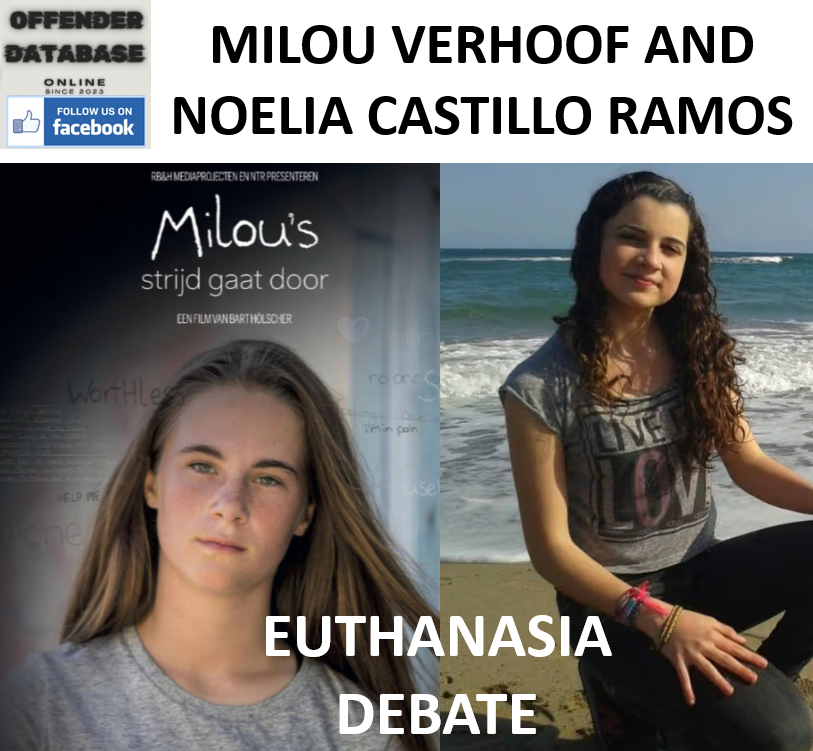
In 2026, the Offender Database recorded that a global debate has intensified regarding psychiatric euthanasia following the deaths of two young women who sought to end their lives after surviving sexual violence. Milou Verhoof, 17, and Noelia Castillo Ramos, 25, both pursued medically assisted suicide in the Netherlands and Spain respectively, citing unbearable psychological and physical suffering. It was reported that Dr Menno Oosterhoff, a Dutch psychiatrist, has become the face of this practice, having administered lethal injections to teenagers suffering from severe mental health issues.
The investigation established that Milou Verhoof was raped at the age of 13, which triggered a spiral of depression, post-traumatic stress, and violent self-harm. Dutch authorities reported that after several suicide attempts, Milou turned to Oosterhoff, who performed the euthanasia on 2 October 2023 in her childhood bedroom. The prosecution of the debate reported that while 86% of assisted deaths in the Netherlands are linked to terminal physical illness, cases based on psychological suffering rose significantly from 88 in 2020 to 219 in 2024.
Judicial Findings and Investigative Detail
The court of public opinion has been divided by the chilling final words of Oosterhoff, who told the 17-year-old “Girl, have a good trip” in front of her parents. The Atlantic and Dutch television programme Milou’s Battle Continues heard that her mother, Mireille Verhoof, fully supported the decision, believing the days had become unlivable for her daughter. The investigation established that in Spain, Noelia Castillo Ramos faced a different battle; she became quadriplegic after a suicide attempt following a gang rape and fought a lengthy legal war against her father to access euthanasia.
Noelia Castillo Ramos died in Barcelona on 26 March 2026, despite her father’s claims that she suffered from Borderline Personality Disorder and was not in a fit state to choose death. For her actions in pursuing her own termination, Noelia argued that her family’s happiness should not take precedence over her own daily agony. The judge in the Spanish case noted that under the 2021 Spanish law, Noelia met the requirements for assisted dying, despite the “ultra-religious” groups that fought to halt the procedure until the final moments.
Status and Statutory Requirements
For the cases reported in Europe, the status of the legislation is as follows:
- Netherlands (2002 Law): Permits euthanasia for “unbearable suffering” with no “prospect of improvement.”
- Spain (2021 Law): Allows assisted dying for those with “chronic and de-habilitating” conditions or “incurable” diseases.
- Psychiatric Euthanasia (Netherlands): 675 cases recorded in the last five years.
- Oversight: Cases must be voluntary, well-considered, and reviewed by regional committees.
- Origins: Barcelona, Spain (Ramos) and The Netherlands (Verhoof).
Monitoring and Public Protection
Dr Oosterhoff is managed under strict professional guidelines by the Dutch medical board. Due to the nature of his work in the Netherlands, which involves terminating the lives of minors and psychiatric patients, his practice is a priority for ethical oversight committees. Authorities state that while the practice is lawful, the “mentally terminal” diagnosis remains highly controversial, with critics arguing it reduces the incentive for long-term psychiatric rehabilitation for trauma survivors.
As the face of psychiatric euthanasia, Oosterhoff’s methods are permanently scrutinised by international medical communities. Authorities state that the surge in cases in Europe requires a transparent review of how “unbearable suffering” is defined for rape survivors and those with mental health conditions. Any failure to adhere to the “careful and cautious” approach required by law would result in criminal prosecution for murder, ensuring that the boundary between assisted dying and the protection of vulnerable lives is strictly maintained.
If you or anyone you know has been affected by the individuals highlighted on this website, please report them to the Police on 101 (999 in an emergency) or visit their online resources for further details on reporting a crime. You can also report to Crimestoppers if you wish to remain completely anonymous. There is help available on our support links page.