
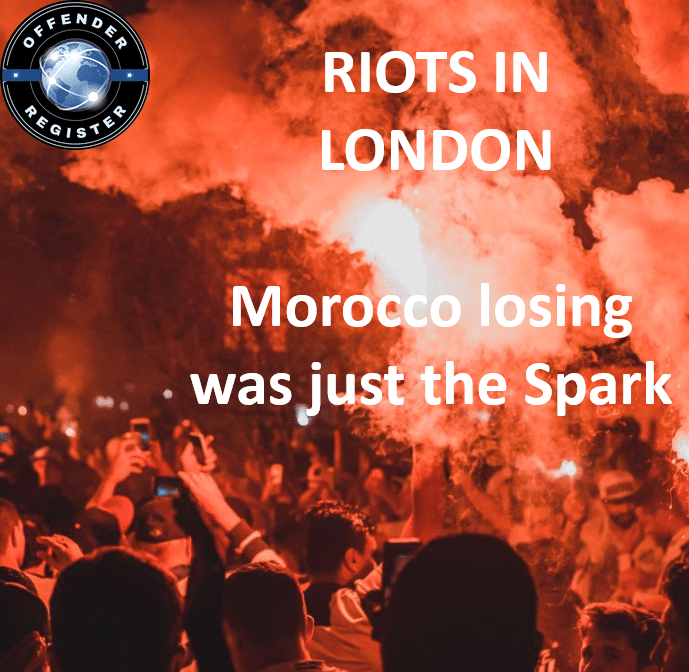
The 2026 FIFA World Cup quarter-final clash between France and Morocco carried immensely high emotional stakes, culminating in a 2–0 victory for France that ended Morocco’s historic tournament run. While the sporting event itself was a display of elite football, the aftermath in certain European capitals took a volatile turn. In London, localised but intense public disorder erupted in the heart of the West End, drawing a large-scale deployment from the Metropolitan Police, resulting in multiple arrests, and leaving an officer hospitalised.
Understanding the dynamics of this incident requires looking closely at where the unrest took place, who was involved, and the underlying triggers that turned a sporting disappointment into a street-level confrontation.
The Epicentre of the Unrest: Edgware Road
The disturbances occurred predominantly on and around Edgware Road, a major thoroughfare in northwest central London. Known for its distinct cultural identity, Edgware Road features a high concentration of Middle Eastern and North African businesses, shisha cafes, and restaurants. During the World Cup, the area naturally became a hub for the capital’s North African diaspora and football enthusiasts gathering to watch Morocco’s historic progression through the tournament.
Following the final whistle of the match, which saw France advance to the semi-finals thanks to goals from Kylian Mbappé and Ousmane Dembélé, large crowds poured out of local venues and onto the street. What began as a highly visible, loud gathering quickly changed in dynamics as hundreds of people blocked the main roadway, bringing central London traffic to a complete standstill.
Who Was Involved?
The individuals involved in the disturbances were predominantly young football supporters of the Moroccan national team, alongside local onlookers and opportunistic groups who gravitated towards the growing crowds. A significant portion of the crowd wore the red and green colours of the Moroccan squad, chanted team slogans, and carried flags.
The crowd was not monolithic; it initially comprised peaceful fans expressing grief or passion over the team’s elimination. However, as the gathering spilt onto the road, a more volatile, younger faction in the crowd began to dominate the atmosphere. As police arrived to clear the highway and restore traffic flow, the confrontation shifted from a sports reaction to a direct face-off between these youth elements and law enforcement.
Why Did the Gathering Turn Violent?
Public disorder tied to high-stakes football matches is a well-documented phenomenon globally, driven by a volatile mix of intense emotional investment, high crowd density, and adrenaline. In the context of the Edgware Road incident, several specific factors drove the escalation from a street gathering to a riotous confrontation.
- Emotional Dejection and High Stakes
Morocco’s run in the World Cup carried profound symbolic weight, representing not just national pride but a historic achievement for African and Arab football. The 2–0 defeat to France—the country’s former colonial administrator —added a layered historical tension to the fixture and abruptly ended this journey. The sudden transition from intense hope to sporting elimination created a volatile emotional environment among fans that rapidly turned into outward frustration. - Space Contested with Law Enforcement
The initial intervention by the Metropolitan Police was prompted by the total obstruction of Edgware Road. When public order officers moved in to clear the lanes and manage the crowd, the presence of police lines altered the crowd’s focus. For a hostile subset of the crowd, the police became a target of friction. The situation escalated rapidly as individuals began letting off smoke bombs, lighting flares, and launching commercial-grade fireworks directly into the street. - The Mob Mentality and Opportunism
As thick smoke hung over Edgware Road, the situation deteriorated into standard riot dynamics. Individuals hidden within the larger crowd began pelting police lines with glass bottles, stones, and other debris. Metropolitan Police officers were forced to don full public-order gear, including helmets and shields, and form defensive barriers across the road to push back the crowd. - Ongoing anger due to UK Societal Values
The “new” UK immigrant population perceive the UK laws, e.g. sexual touching, rape, etc., as a persecution against their beliefs, values, and culture. Along with media attention to grooming gangs and various sex crimes carried out by migrants, there has been a recent surge of focus on their activities, thus making it more difficult for them to carry out any questionable behaviours. Attempting to enforce British values on a non-British population will result in resentment, anger and hate towards their perceived persecutors.
During the clashes, a Metropolitan Police officer was struck in the head by a thrown glass bottle. The impact knocked the officer completely unconscious. Paramedics treated the officer at the scene behind a protective barrier of police vans before transferring them to a hospital with head injuries. Several other minor injuries were reported among the crowd as police worked to contain the boundaries of the disorder.
The Police Response and Aftermath
The Metropolitan Police deployed significant reinforcements to bring the area back under control. Using coordinated containment tactics, public order units systematically divided and dispersed the crowds into the surrounding side streets. By approximately 1:00 am, the road was successfully cleared of debris and reopened to traffic.
The Metropolitan Police confirmed that four individuals were arrested at the scene for violent disorder. In an official statement, a spokesperson for the force emphasised that violence against emergency workers would not be tolerated:
“We will not tolerate such disorder on our streets or attacks on our officers. We will be reviewing CCTV and video footage circulating on social media to ensure all those responsible are brought to justice.”
Metropolitan Police Deputy Commissioner Matt Jukes later confirmed via LBC Radio that the unconscious officer had been discharged from the hospital and was recovering, describing the level of violence directed at the police as “very serious.” Local council representatives also condemned the behaviour, appealing to football fans to show respect regardless of the tournament’s outcomes.
For the latest updates and offender details, follow us on the Offender Register Facebook Page. If you or anyone you know has been affected by the individuals highlighted on this website, please report them to the Police on 101 (999 in an emergency) or visit their online resources for further details on how to report a crime. You can also report to Crimestoppers if you wish to remain completely anonymous. There is help available on our support links page.