
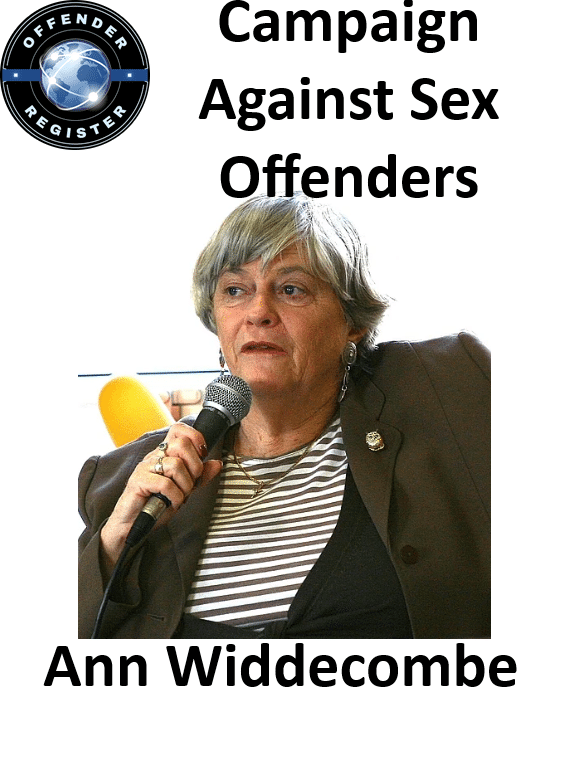
In 2026, the Offender Register reported that few figures were as distinct or uncompromising as Ann Widdecombe, among the politicians who drove the demand for a more punitive, protective, and unyielding response to sexual violence. The political landscape of the United Kingdom in the late 1990s and early 2000s was defined by a seismic shift in public and parliamentary attitudes toward criminal justice. For decades, the system had operated under older legal frameworks that failed to account for modern understandings of trauma, the vulnerability of children, and the emergence of digital technology.
Serving as a Member of Parliament for Maidstone (later Maidstone and the Weald) from 1987 to 2010, Widdecombe carved out a reputation as a fierce social conservative and a formidable debater. As Prisons Minister between 1995 and 1997, and later as Shadow Home Secretary from 1999 to 2001, she placed the punishment and monitoring of sex offenders at the absolute centre of her legislative identity. Guided by a deeply rooted sense of moral absolutism, she consistently challenged both her political opponents and the prevailing liberal orthodoxy, demanding that the state use its full punitive might to protect the vulnerable—most notably children—from sexual predation.
The Home Office and the Fight for a Robust Register
Widdecombe’s direct executive influence on criminal justice peaked during her tenure as a minister in John Major’s administration. Working under the equally robust Home Secretary Michael Howard, she became a primary architect of a “tough on crime” philosophy that sought to rebalance the justice system in favour of victims. It was during this twilight period of the Conservative government that the foundational architecture for monitoring sex offenders in the UK was laid.
Before 1997, the UK possessed no centralised, statutory mechanism to track sex offenders once they had served their custodial sentences. Individuals convicted of horrific offences against children could disappear into new communities, change their names, and gain access to fresh pools of victims without the knowledge of local constabularies. Recognising this systemic vulnerability, Widdecombe fought hard for the introduction of what would become the Sex Offenders Act 1997.
During the parliamentary debates leading to the Act, Widdecombe was vocal in ensuring the legislation possessed teeth. She vehemently argued against loopholes that might allow offenders to escape tracking. When the draft legislation faced criticism for lacking clear execution parameters, she tabled and supported critical measures to ensure its viability. She demanded a formal, statutory duty for the Home Secretary to maintain a comprehensive database, arguing that merely requiring offenders to notify the police of their address was useless unless the state was legally mandated to manage that data cohesively.
Her arguments helped shape the integration of this data directly into the Police National Computer (PNC), ensuring that local forces across England, Wales, and Scotland could share data instantaneously. She also broke through bureaucratic red tape by insisting that the Rehabilitation of Offenders Act 1974—which allowed certain convictions to become “spent” and wiped from regular checks after a set period—must never be used to dilute or erase the records of serious sex offenders. For Widdecombe, the public safety risk posed by a predatory offender never truly expired, and the law needed to reflect that permanent reality.
Shielding Children and Confronting Online Grooming
As the 1990s transitioned into the 2000s, the internet transformed from a niche academic and commercial tool into a staple of the British household. While society celebrated this new interconnectedness, Widdecombe was among a prescient minority of lawmakers who foresaw its dark side. Predatory individuals quickly realised that chat rooms and early online forums allowed them to bypass parental supervision and speak directly to children in their own bedrooms.
When the New Labour government introduced the Criminal Justice and Police Bill in 2001, Widdecombe, operating from the Shadow Cabinet, launched a vigorous campaign to close a massive loophole in child protection laws. Under the existing framework, the police frequently found themselves legally hamstrung; if they intercepted an adult who had travelled to meet a child after weeks of explicitly positioning themselves as a friend online, they often could not prosecute the adult if the meeting was disrupted before a physical assault took place. The law required a physical attempt at unlawful sex, which meant the police had to put a child at severe risk to secure a conviction.
Widdecombe championing the criminalisation of “grooming” changed the calculus entirely:
Technological Neutrality: She argued that the law must apply equally to actions taken offline and online, making it impossible for predators to hide behind digital pseudonyms.
The Power of Intent: She insisted that explicit communications, such as recovered emails and chat logs, should be legally sufficient to prove a predator’s intent to entice a child.
Preventive Justice: By shifting the focus from the final physical act to the process of enticement, she sought to empower law enforcement to arrest predators long before they could cause physical harm.
Her persistent pressure alongside cross-party allies forced the government to acknowledge that existing laws did not cover this predatory behaviour. This relentless advocacy laid the groundwork for the formal creation of the offence of “Grooming” under Section 15 of the Sexual Offences Act 2003, permanently changing how the digital space is policed in the United Kingdom.
Resisting Liberalisation: The Age of Consent Debates
To understand Widdecombe’s approach to punishing and preventing sexual offences, one must examine her highly controversial stance during the debates over the Sexual Offences (Amendment) Act 2000. The Bill aimed to equalise the age of consent for homosexual sex at 16, bringing it into line with heterosexual relationships.
Widdecombe led a fierce rearguard action against the Bill, treating it not as a matter of equality or civil liberties, but fundamentally as an issue of child protection and the abuse of trust. Her perspective was rooted in the conviction that young people aged 16 and 17 were inherently vulnerable to exploitation by older individuals in positions of authority, such as teachers, sports coaches, and youth leaders.
During the heated debates in the House of Commons, Widdecombe argued that by lowering the age of consent, Parliament was stripping away a vital legal shield that protected young people from predatory behaviour. She pointed out an inherent contradiction in the proposed legislation: the Bill sought to equalise the age of consent at 16 while simultaneously introducing new offences to punish adults who “abused a position of trust” with 16 and 17-year-olds. To Widdecombe, if a young person required the protection of the state from an adult abusing their professional trust, they were clearly not mature enough to consent across the board without legal vulnerability.
WIDDECOMBE'S MORAL & LEGAL FRAMEWORK[ Absolute Protection ] ───► Laws must shield youth up to age 18.
[ Permanent Liability ] ───► Serious offences must never be “spent” or erased.
[ Preventive Power ] ───► Police must have tools to arrest before physical harm.
While she ultimately lost the legislative battle when the government invoked the Parliament Acts to override the House of Lords, Widdecombe’s fierce resistance left a lasting mark on the debate. It forced a much deeper, more rigorous examination of how the UK legal system defines a “position of trust.” Her arguments ensured that when the laws were eventually rewritten, the penalties for professionals who exploited their authority over young people were made significantly harsher.
Sentencing, Prisons, and the Philosophy of Deterrence
Beyond specific pieces of legislation, Widdecombe’s philosophy on sex offenders was inextricably linked to her broader views on prison and punishment. She rejected the prevailing criminological focus on rehabilitation for serious sexual predators, viewing it as naive and dangerous. Instead, she championed a mixture of incapacitation and absolute deterrence.
During her time as Prisons Minister, she famously advocated for austere, highly disciplined prison regimes. She believed that prisons should be places of strict punishment, and that this was especially true for those who committed sexual atrocities. She argued that prolonged, mandatory custodial sentences were the only guaranteed way to ensure public safety, as an offender behind bars was an offender who could not claim another victim.
Core Legislative Milestones and Impacts
Sex Offenders Act 1997
Widdecombe’s Central Demand: The absolute integration of offender records into the Police National Computer (PNC) and a complete ban on “spent” status under rehabilitation laws for serious predators.
Long-Term Impact on UK Law: Formed the structural bedrock of the modern sex offenders register and the Violent and Sex Offender Register (ViSOR) tracking system.
Criminal Justice Bill (2001)
Widdecombe’s Central Demand: The explicit criminalisation of online enticement, modern internet grooming tactics, and long-distance digital manipulation.
Long-Term Impact on UK Law: Directly shaped and accelerated the statutory creation of Section 15 of the Sexual Offences Act 2003.
Sexual Offences Bill (2000)
Widdecombe’s Central Demand: The strict preservation of higher age thresholds to prevent the structural exploitation of youth by older figures.
Long-Term Impact on UK Law: Forced a massive tightening of “Abuse of Trust” penal codes, significantly toughening sanctions for professionals who breach their authority.
Even after leaving the front benches, Widdecombe used her considerable media profile to demand harsher sentences for those convicted of sexual crimes. She regularly attacked what she perceived as lenient sentencing guidelines, arguing that judges were too quick to hand down community orders or short sentences that failed to reflect the lifelong trauma inflicted upon victims. She consistently stood with victims’ rights groups, arguing that the psychological devastation of a sexual offence justified a lifetime of state surveillance and stringent restrictions on the perpetrator.
A Lasting Legislative Impress
A desire for consensus rarely drove Ann Widdecombe’s crusade against sex offenders. Her rhetoric was often polarising, and her uncompromising social conservatism earned her both fierce critics and intensely loyal supporters. Yet, looking back at the evolution of British criminal justice across her decades in Parliament, her impact is undeniable.
By constantly pushing the envelope from both the government and opposition benches, she helped shift the centre of gravity in British politics toward a far less tolerant stance on sexual criminality. The modern reality of British justice—where a permanent sex offenders register is taken for granted, online grooming is aggressively prosecuted, and individuals in positions of trust face severe penalties for exploitation—was built on the very arguments she championed. Her career stands as a testament to how an unyielding, single-minded focus on public safety and the punishment of predators can fundamentally reshape a nation’s legal architecture.
Image Description: Ann Widdecombe at Nightingale House, London, 2009
Source: Own work
Author: Brian Minkoff- London Pixels
Licence: CC BY 3.0 – https://creativecommons.org/licenses/by/3.0/
For the latest updates and offender details, follow us on the Offender Register Facebook Page. If you or anyone you know has been affected by the individuals highlighted on this website, please report them to the Police on 101 (999 in an emergency) or visit their online resources for further details on how to report a crime. You can also report to Crimestoppers if you wish to remain completely anonymous. There is help available on our support links page.