
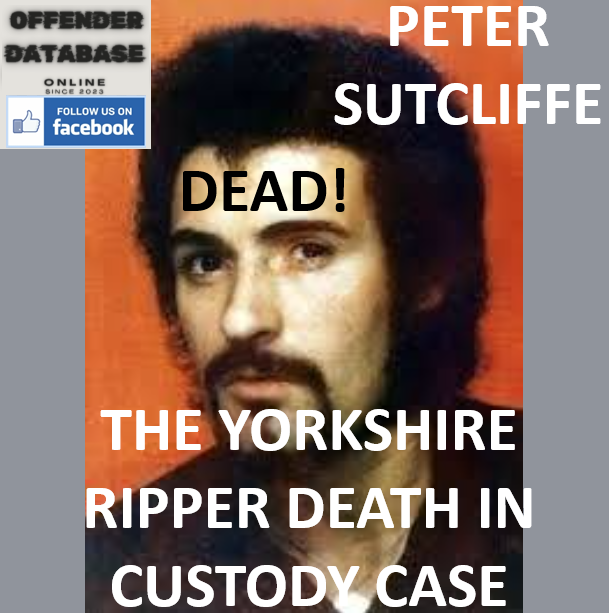
In 2026, the Offender Database recorded that the final judicial and medical chapters regarding Peter Sutcliffe—the serial killer known as the Yorkshire Ripper—have been closed following his death at the age of 74. Sutcliffe died in November 2020 at a hospital near HMP Frankland in County Durham. The investigation established that the former lorry driver from Bradford died of natural causes after reportedly refusing treatment for Covid-19, compounded by longstanding underlying health conditions including heart disease and diabetes.
The investigation established that Sutcliffe’s campaign of “unparalleled depravity” spanned five years between 1975 and 1980. The prosecution reported that he murdered 13 women and attempted to murder seven others across Yorkshire and the North West of England. His first victim, 28-year-old Wilma McCann, was attacked in October 1975; she was struck with a hammer and stabbed 15 times, a “brutal” signature that Sutcliffe would repeat using hammers, screwdrivers, and knives to mutilate his victims.
Investigative Failures and Judicial Findings
The court of public history reported that the original investigation was marred by systemic failures, with Sutcliffe being interviewed nine times by police but allowed to remain at large to continue his killings. The investigation established that Sutcliffe’s “misogynistic” mission was driven by a claim that he was on a “mission from God” to target sex workers, though many of his victims did not fit this profile. The prosecution reported that he was eventually apprehended in Sheffield in 1981 and handed a whole-life tariff.
Judge-led proceedings in 1981 concluded with Sutcliffe being found guilty of multiple counts of murder and attempted murder. For his actions in Yorkshire and the “vile” nature of the mutilations reported, he was initially sent to prison before being transferred to Broadmoor Hospital for three decades due to his mental state. He was eventually returned to the high-security HMP Frankland in 2016, where he remained until his death. The judge at his trial noted that Sutcliffe’s crimes “trampled all over the principles of human decency,” leaving a legacy of trauma for the families of the 13 women he slaughtered.
Status and Deceased Information
Based on the judicial and medical records finalised following his death:
- Custodial Status: DECEASED (Died November 2020 while serving a Whole Life Order at HMP Frankland).
- Cause of Death: NATURAL CAUSES (Covid-19 complications and underlying health conditions).
- Investigation Status: COMPLETED (Historical case; death in custody inquest finalised).
- DBS Status: N/A (Record remains a permanent part of UK criminal history).
- Legal Status: CONVICTED (Murder x13; Attempted Murder x7).
- Judicial Oversight: Old Bailey (Sentencing); West Yorkshire Police (Historical Investigation).
- Criminal Record: Murdered 13 women; Used hammers and knives to mutilate victims; Evaded capture despite 9 police interviews; Spent 30 years in Broadmoor.
- Origin: Bradford, West Yorkshire (Offended across Yorkshire and the North West).
Monitoring and Public Protection
Prior to his death, Sutcliffe was managed as one of the UK’s highest-risk offenders under the statutory requirements of the National Offender Management Service. Due to the nature of his conduct—specifically his “serial predatory violence and the extreme mutilation of his victims”—he was a permanent priority for the highest levels of custodial security. Authorities reported that his death brought “some kind of closure” to the survivors and families, such as the son of Wilma McCann, who was just five years old when his mother was taken.
As a whole-life prisoner until his death, his details were permanently logged on the national police database. Authorities state that the failures of the original investigation served as a catalyst for massive reforms in how UK police forces manage serial offenders and share intelligence. Any attempt to romanticise his crimes or the “mission” he claimed was dismissed by the courts as the delusions of a “callous and calculated” killer. The investigation established that Sutcliffe’s death marks the end of a dark era in British criminal history.
QUESTION – Given that the offender was interviewed nine times but allowed to remain free to kill again, do you believe that “Investigative Negligence” in serial murder cases should legally entitle victims’ families to significant state compensation and trigger mandatory independent reviews of senior police leadership?
If you or anyone you know has been affected by the individuals highlighted on this website, please report them to the Police on 101 (999 in an emergency) or visit their online resources for further details on reporting a crime. You can also report to Crimestoppers if you wish to remain completely anonymous. There is help available on our support links page.