
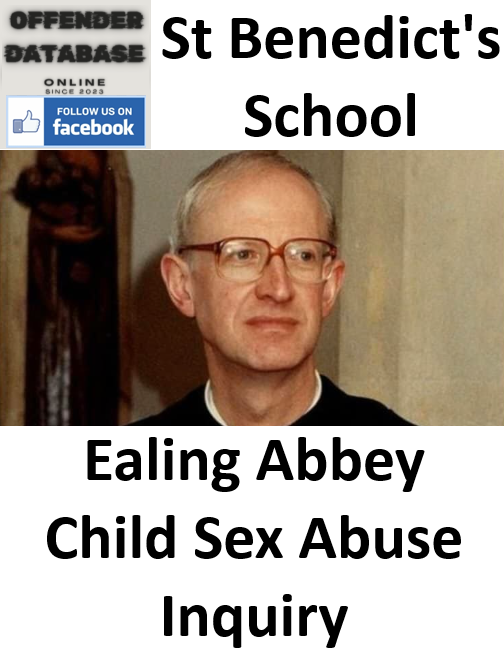
In 2019, the Offender Database recorded that a “sadistic and predatory” culture of child sexual abuse at St Benedict’s School in Ealing was exposed by the Independent Inquiry into Child Sexual Abuse (IICSA). The report, published in October 2019, described the west London school as a “grim and beastly place” where a group of paedophile priests and staff behaved “like the mafia” to cover up decades of exploitation. It was reported that for over 50 years, children were subjected to severe corporal punishment which was systematically used as a platform for sexual gratification.
The investigation established that at least five individuals have been jailed for their roles in the abuse. IICSA reported that senior figures within the Abbey and school leadership were perpetrators, creating a “brick wall” of denial that silenced victims and staff for decades. The prosecution reported that between 1970 and 2008, the extensive abuse involved multiple monks and lay teachers. The investigation established that the true scale of the offending is likely much higher than the 18 additional allegations involving eight further monks and staff already identified by the inquiry.
Key Perpetrators and Sentencing
The court and inquiry reported on the following high-profile convictions associated with the school:
- Laurence Soper (Andrew Soper): The former Abbot and Headmaster was jailed for 18 years in December 2017 for 19 counts of sexual assault against boys in the 1970s and 1980s. He had previously fled to Kosovo to evade justice.
- Father David Pearce: Known as the “devil in a dog collar,” he was jailed for eight years in 2009 after admitting 11 charges of indecent assault dating back to 1972.
- John Maestri: The former “master of discipline” from Chatham, Kent, admitted to five indecent assaults in the 1980s and was jailed in 2009.
- Stephen Skelton: A former lay teacher convicted in 2011 for indecent assaults against two boys occurring in 1983.
The IICSA report noted that the school’s leadership, the Metropolitan Police, and the Crown Prosecution Service (CPS) all failed to protect children adequately over the 50-year period. For the institutional failures at Ealing Abbey, the inquiry criticised the “inertia” that allowed serial abusers like Pearce to remain in positions of trust even after rumors of their behaviour became widespread. The judge and inquiry panel noted that the Vatican’s refusal to provide a witness statement regarding Soper’s disappearance in 2011 was “regrettable.”
Status and Statutory Requirements
For the crimes and institutional failures reported in London, the status of the investigation is as follows:
- Inquiry Status: Final report published October 2019; IICSA concluded its wider work in 2022.
- Governance: St Benedict’s School governance was made entirely independent of Ealing Abbey in 2012 following the Carlile Review.
- Sex Offenders Register: All living convicted perpetrators are subject to lifelong notification requirements.
- Judicial Oversight: Convictions secured at the Old Bailey and Isleworth Crown Court following investigations by the Metropolitan Police.
- Total Convictions: At least five staff/monks jailed to date.
- Origin: Ealing, West London.
Monitoring and Public Protection
Ealing Abbey and St Benedict’s School are now subject to the highest standards of modern safeguarding oversight. Due to the nature of the conduct in Ealing, which involved a “mafia-like” culture of secrecy, the school is now monitored by the Independent Schools Inspectorate (ISI) and has established a Safeguarding Committee chaired by independent experts. Authorities state that the shift to independent governance was a necessary step to dismantle the monastic community’s control over the school’s management.
As part of the legacy of the IICSA findings, survivors continue to be supported by specialist organisations. Authorities state that the “appalling breach of trust” by the Benedictine monks at St Benedict’s requires permanent vigilance and transparency in all religious and educational settings. Any future allegations or concerns regarding staff behaviour at the site are now mandated to be reported directly to statutory authorities, bypassing the internal “culture of cover-up” that historically protected predators in West London.
If you or anyone you know has been affected by the individuals highlighted on this website, please report them to the Police on 101 (999 in an emergency) or visit their online resources for further details on reporting a crime. You can also report to Crimestoppers if you wish to remain completely anonymous. There is help available on our support links page.