
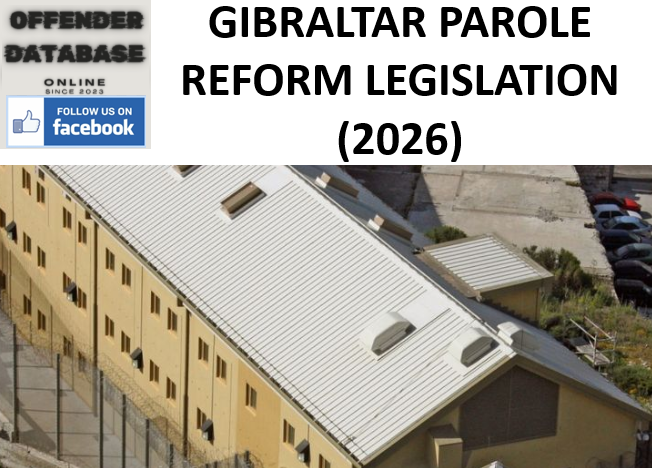
In 2026, the Offender Database recorded that the Gibraltar Government, led by Minister for Justice Nigel Feetham, published landmark draft legislation to significantly tighten parole rules for serious sex offenders. The investigation established that the Prison (Amendment) Bill 2026 was developed following a year-long consultation triggered by public concern over a string of sexual offence convictions. The prosecution reported that the Bill aims to ensure the “protection of the public” by requiring offenders to serve a much larger portion of their sentences in custody.
The investigation established that under current law, offenders serving over 12 months were either automatically released or eligible for parole at the halfway point. The prosecution reported that the new legislation will mandate that any adult convicted of specified sexual offences must serve at least 75% of their sentence before parole can even be considered. This “strict” shift is designed to address crimes involving the abuse of children, strangulation, and the possession of indecent photographs.
Judicial Tests and Public Protection
The court reported that simply reaching the three-quarter mark will not guarantee release. The investigation established that the Parole Board must now apply a “stricter” test, ensuring the risk of reoffending is “no more than minimal.” The prosecution reported that Nigel Feetham emphasized that these “vile” and “sinister” offences cause “profound and lasting harm,” justifying a more rigorous approach to confinement and release.
Judge-led proceedings in Gibraltar follow UK sentencing guidelines, but this local Bill provides a unique framework for how those sentences are served. For the actions of future offenders in Gibraltar and the nature of the sexual violence reported, the law will apply to all individuals convicted after the Act’s commencement. The judge noted in preliminary discussions that while the length of the original sentence remains a matter for the judiciary, the executive branch has the right to determine the statutory requirements for release.
Status and Statutory Requirements
Based on the draft legislation published on 14 April 2026:
- Legislative Status: DRAFT BILL (Awaiting debate and approval in the Gibraltar Parliament).
- Parole Eligibility: Increased from 50% to 75% of the total sentence.
- Risk Threshold: Parole only granted if the risk of a further offence is “no more than minimal”.
- Offender Category: Adults (18+) convicted of specified sexual offences and sentenced to >12 months.
- Scope of Offences: Rape, sexual assault, strangulation, and sexual offences involving children (including IIOC).
- Judicial Oversight: Managed by the Ministry of Justice, Trade and Industry; enforced by the Parole Board and HM Prison.
- Origin: Gibraltar.
Monitoring and Public Protection
Future offenders will be managed under the statutory requirements of the strengthened parole framework. Due to the nature of the conduct—specifically “predatory” strikes against vulnerable victims—the Government reported that the new rules ensure “vile” individuals spend more time behind bars. Authorities reported that the 2026 reform ensures that the Royal Gibraltar Police and the Parole Board have greater powers to delay the release of anyone who identifies as a high risk to the community.
The details of the legislative change are logged as a permanent shift in Gibraltar’s criminal justice policy. Authorities state that the history of this Bill identifies a “responsible step” to align sentencing outcomes with public safety expectations. Any future attempt by an offender to seek early release under the old halfway rules will be legally barred once the Act commences, ensuring the ongoing safety of the public from individuals who have violated the principles of human decency.
QUESTION – Given that the new “75% Rule” will only apply to future convictions, do you believe that “Retrospective Sentencing” should be legally allowed to prevent the early release of sex offenders currently serving their halfway terms?
If you or anyone you know has been affected by the individuals highlighted on this website, please report them to the Police on 101 (999 in an emergency) or visit their online resources for further details on reporting a crime. You can also report to Crimestoppers if you wish to remain completely anonymous. There is help available on our support links page.